Compare International Travel eSIM Providers for Your Trip
Choosing a travel eSIM gets complicated quickly once you start opening provider websites. A plan that makes sense for a five-day city break may be a poor fit for a three-week trip, frequent hotspot use or travel across several countries.
The Travel eSIM Comparison Tool narrows those choices using four things that actually matter for the trip: destination, trip length, expected data use and your main priority.
Use the tool to narrow the field before opening individual provider websites and comparing the plans currently available for your trip.
Travel eSIM Plan Comparison Tool
Choose your destination, trip length, data use, and priority to compare travel eSIM providers that currently list coverage for your destination.
Important: Provider coverage, plan availability, data allowances, hotspot rules, validity periods, network access, fair-use policies and promotions can change at any time. The comparison tool is designed to help narrow your options based on your destination, trip length, expected data use and priority. Always confirm the current plan details and final price directly on the provider’s website before purchasing.
Last checked: September 16, 2026
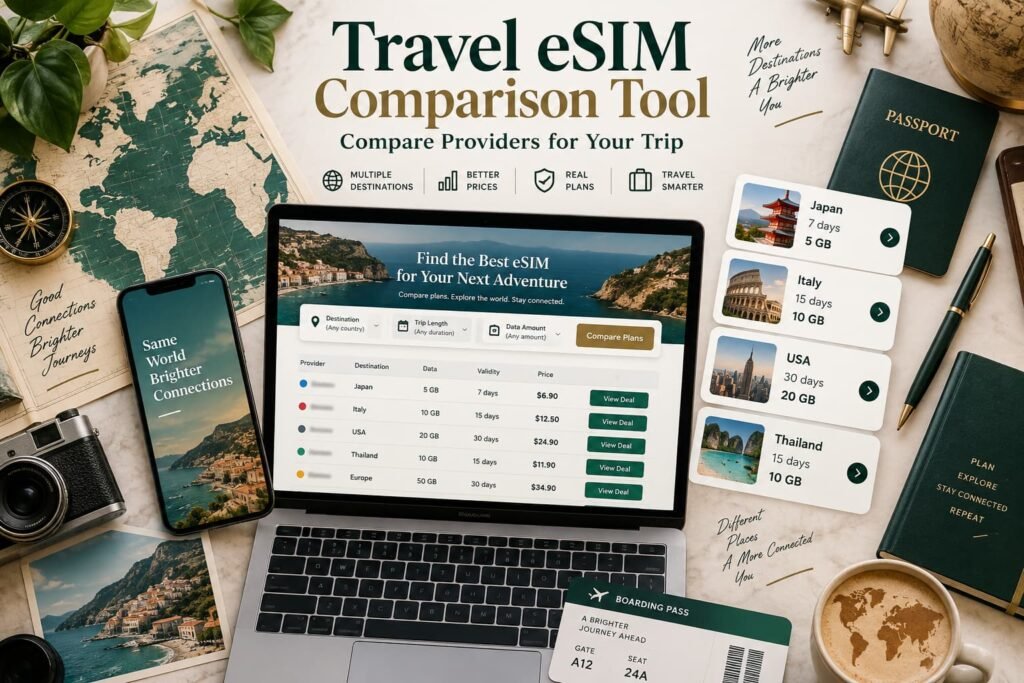
Quick Answer: How the Travel eSIM Comparison Tool Works
Start by selecting where you are travelling. Then choose your trip length, estimate how you expect to use mobile data and select what matters most for this particular trip.
The results update automatically as those selections change. The tool highlights a Best Match, Another Good Option and an Alternative, followed by a broader provider comparison showing availability, data style, general use case and links to current provider plans.
The process is straightforward:
- Select your destination.
- Choose your trip length.
- Estimate your data usage.
- Pick your main priority.
- Review the top matches and provider table.
- Check the provider’s current plan details before purchasing.
A provider review is also available where one has already been published on eSIMTravelGuide.com. Otherwise, the comparison may show that the review is coming soon.
How to Use the Travel eSIM Plan Comparison Tool
1. Choose Your Destination
Destination comes first because travel eSIM coverage is not universal.
The tool filters the provider database according to the destination coverage currently loaded for each provider.
If your trip crosses several countries, also consider whether a regional or global plan would make more sense than purchasing separate country plans.
2. Select Your Trip Length
A weekend, two-week vacation and month-long stay create very different mobile-data requirements.
Choose the trip length that most closely matches how long you expect to need the eSIM. The deeper plan details, including validity and top-up options, can be checked once you have narrowed the provider shortlist.
3. Estimate Your Data Usage
Think about what you normally do when travelling rather than trying to predict an exact gigabyte total.
Maps, messaging and email generally create a different usage pattern from frequent social-media uploads, streaming, video calls or working from a laptop through your phone’s hotspot.
Remote work deserves particular attention. Video meetings, cloud files and tethering can consume considerably more data than checking directions and sending messages throughout the day.
Choose the usage level that most closely resembles the trip you are planning.
4. Choose What Matters Most
The lowest-priced plan is not automatically the right plan for every traveller.
The tool lets you prioritize:
- Best overall fit
- Budget-friendly
- Unlimited data
- Broad destination coverage
- Simple setup
Changing that selection can change the recommended providers because the comparison is responding to a different travel priority.
For example, someone travelling through several countries may value broad coverage more than a traveller spending one week in a single city. Someone planning to work remotely may care more about data structure and hotspot requirements.
5. Compare the Results
Start with the three highlighted matches, but do not stop there.
The full provider table lets you see additional options available for the selected destination and compare characteristics such as data style and what each provider is generally suited to.
Use View Current Plans when you are ready to confirm what the provider currently offers. Where eSIMTravelGuide.com has published a full provider review, Read Review gives you a deeper look before you buy.
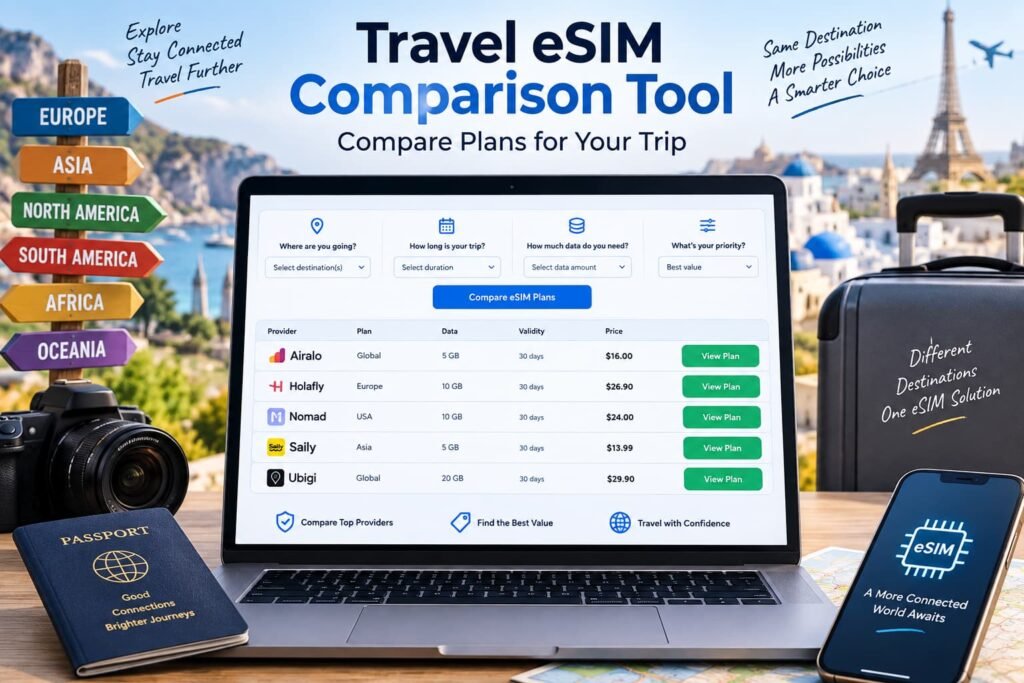
What the International Travel eSIM Comparison Tool Actually Compares
The comparison tool is designed to narrow a crowded eSIM market into a more manageable shortlist.
Its recommendation logic considers the destination coverage information loaded into the tool together with your:
- destination
- trip duration
- expected data use
- selected priority
- preference for budget-oriented options
- preference for unlimited-style data
- need for broader destination coverage
- preference for straightforward setup
It then uses those inputs to identify providers that appear better aligned with the selected trip.
What It Does Not Compare in Real Time
This distinction matters.
The tool is not a live checkout-price engine. It does not continuously calculate every provider’s current price, promotion, local mobile network, fair-use threshold or hotspot restriction.
It also does not measure current network performance at your location.
Those details can vary by provider, country and individual plan. Always open the current provider page before purchasing and confirm the exact package you are considering.
What Makes One Travel eSIM Better for a Particular Trip?
There is no single feature that determines the right travel eSIM.
A useful comparison starts with how and where you expect to use it.
Destination Coverage
First verify that the plan covers every place where you need mobile data.
That sounds simple for a one-country trip. It becomes more important when the itinerary includes border crossings, islands, stopovers or several countries.
Trip Duration
Check plan validity against the complete travel period.
A large data allowance is not particularly helpful when its validity ends several days before the trip does. For longer travel, check whether the plan can be topped up or extended if you need more data before the trip ends.
Capped or Unlimited-Style Data
Consider whether you prefer a fixed allowance or an unlimited-style plan. The differences go beyond total data, so compare high-speed allowances, fair-use terms and hotspot rules before deciding.
Hotspot Requirements
Hotspot support becomes much more important if a laptop, tablet or travelling companion will depend on the phone’s connection.
Do not assume an unlimited phone-data plan automatically provides unlimited tethering. Hotspot allowances and restrictions can differ from the main mobile-data allowance.
Local, Regional or Global Coverage
Someone flying directly to Japan and returning home has different needs from someone travelling through six European countries.
A country-specific plan may be the simplest fit for a single destination. Regional plans can reduce the need to switch eSIMs while crossing nearby countries. Global products can make sense for longer itineraries spanning several regions, although the broader coverage should still be checked against the actual route.
Calls and Text Messages
Many travel eSIM packages are primarily designed for mobile data.
If receiving conventional calls or SMS messages on a new number is important, confirm that the exact plan supports them. Messaging and calling through data-based apps are not the same as having regular cellular voice and SMS service.
Activation Timing
Check when the plan’s validity begins.
Some products start when the eSIM first connects to an eligible network at the destination, while other activation rules can differ. Confirming this before installation helps prevent using part of a short validity period earlier than intended.
Capped Data vs Unlimited-Style eSIM Plans
Neither format is automatically better.
A capped-data plan gives you a defined amount such as a fixed number of gigabytes. It can be a practical choice when most mobile use will involve maps, messaging, bookings and occasional browsing.
An unlimited-style plan can be more convenient for travellers who expect heavier use and do not want to monitor a fixed allowance constantly.
The important part is reading what unlimited means for the specific plan.
Depending on the provider and destination, there may still be:
- a daily or other high-speed-data threshold
- temporary speed management
- fair-use conditions
- separate hotspot limits
- network-management policies
For that reason, compare the plan conditions rather than relying on the word unlimited alone.
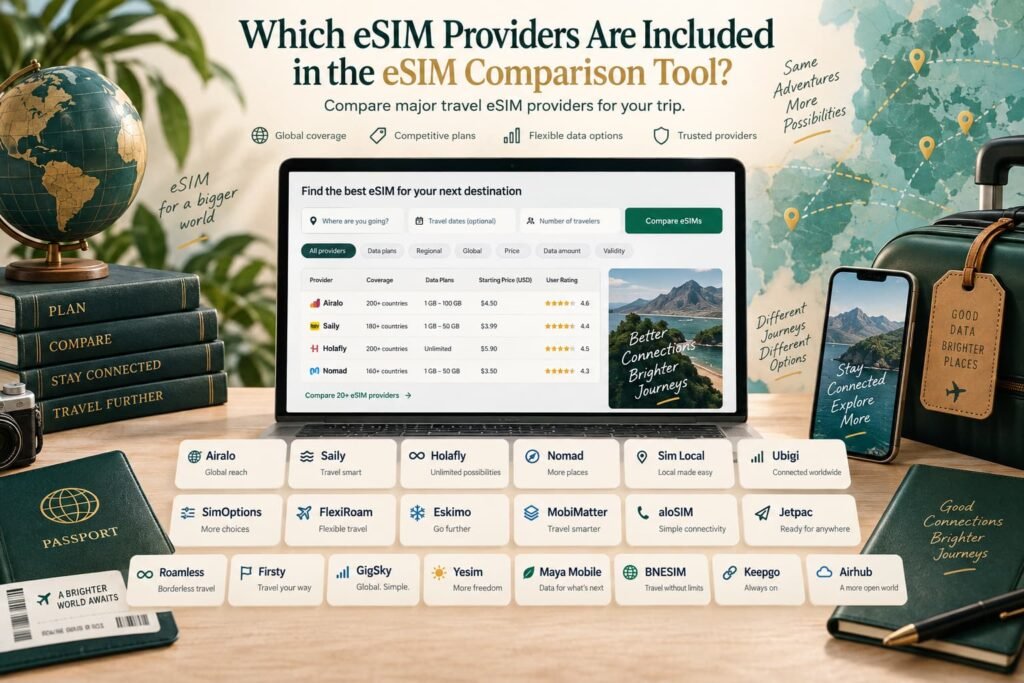
Which eSIM Providers Are Included in the eSIM Comparison Tool?
The current comparison database contains 20 travel eSIM providers:
Airalo, Saily, Holafly, Nomad, Sim Local, Ubigi, SimOptions, FlexiRoam, Eskimo, MobiMatter, aloSIM, Jetpac, Roamless, Firsty, GigSky, Yesim, Maya Mobile, BNESIM, Keepgo and Airhub.
They do not necessarily appear for every destination. The comparison filters the available provider set using the destination coverage information currently loaded into the tool.
This page deliberately does not turn those 20 names into 20 mini-reviews. Provider features, plan structures and destination offerings change, and detailed provider evaluation belongs in the individual eSIM reviews.
The purpose of the comparison tool is to make the first stage easier: reduce a large provider universe to a smaller group worth investigating for your trip.
Travel eSIM vs Regional eSIM vs Global eSIM
The geographic structure of the trip can be just as important as data allowance.
Country eSIM
A country-specific eSIM is usually the simplest place to start when your trip stays primarily within one destination.
You only need to verify the coverage, validity and features for that country rather than evaluating a much larger regional footprint.
Regional eSIM
Regional plans can be useful when several countries are part of the same itinerary.
Instead of installing a different plan at every border, one regional eSIM may cover multiple destinations. Check the complete country list rather than assuming every nearby country is included.
Global eSIM
Global plans can be convenient for frequent travellers or trips that cross several regions.
Coverage still varies, so “global” should be treated as a product category rather than a guarantee that every country on the itinerary is included.
Check Your Phone Before Buying an eSIM
A good plan is useless if the device cannot install or use it.
Before purchasing, use the eSIM Compatibility Checker to confirm that your exact phone model supports eSIM.
Also check whether the device is carrier locked. A phone can support eSIM technically while still being restricted from using a travel eSIM supplied by another carrier or provider.
Model and regional variations matter as well. Two phones carrying the same general product name can have different SIM capabilities depending on where they were sold.
Dual-SIM behaviour is another consideration if you intend to keep your regular phone line active for calls or messages while using the travel eSIM for data.
When a Roaming Cost Calculator Is More Useful
The Travel eSIM Comparison Tool answers:
Which travel eSIM providers appear to fit this trip?
The Roaming Cost Calculator answers a different question:
How does using a travel eSIM compare with continuing to use my home carrier’s roaming option?
Use the roaming calculator first when you have not yet decided whether buying a travel eSIM is worthwhile.
Use this comparison tool when you have reached the next stage and want to narrow the eSIM providers themselves.
Keeping those decisions separate makes both comparisons much easier to understand.
Frequently Asked Questions About the Travel eSIM Comparison Tool
How does the travel eSIM comparison tool choose the top matches?
The tool uses the details you select, including destination, trip length, expected data use and priority, together with the provider information currently loaded into the comparison database.
It then narrows the available international travel eSIM providers and highlights a Best Match, Another Good Option and Alternative for that specific trip. These are not permanent rankings. Changing your destination, trip length, data needs or travel priority can change which providers appear at the top.
This approach helps you compare travel eSIM providers based on trip fit rather than relying only on headline pricing or one generic provider ranking.
What does “Available” mean in the provider table?
Available means the provider is currently included in the tool’s loaded coverage information for the destination you selected. It indicates that the provider lists travel eSIM coverage for that country or territory based on the coverage data currently used by the comparison tool.
It does not mean that every travel eSIM plan normally offered by that provider is available for your destination, or that plan details have remained unchanged. Data allowances, validity periods, hotspot support, unlimited-data conditions and pricing can vary by destination and plan.
Use View Current Plans before purchasing to confirm the provider’s current eSIM options, data allowance, validity, hotspot rules and final checkout price for your trip.
Why should I check the provider’s plan again before buying?
Travel eSIM plans can change after you first compare providers. A company may update destination coverage, data allowances, validity periods, hotspot rules, fair-use conditions or pricing.
Before purchasing, open the provider’s official plan page and confirm the current details for your destination, including the included data, validity, tethering rules and final checkout price.
The comparison tool helps narrow your options, but the provider’s website should remain the final source for current plan information.
Why should I check the provider’s plan again before buying?
Travel eSIM products can change between the time you first compare providers and the time you are ready to purchase.
Providers may add or remove packages, adjust coverage, change data allowances or alter plan conditions. The official provider page should therefore be the final check for availability, validity, hotspot rules and pricing before payment.
Are unlimited travel eSIM plans really unlimited?
Some plans provide unlimited total data while still applying limits to how much high-speed data is available during a particular period. Fair-use policies or network management can also reduce speeds after heavier usage.
Hotspot allowances may have separate limits as well. Check the current terms for the exact destination and plan rather than assuming every provider defines unlimited data in the same way.
That keeps the useful semantic language around unlimited travel eSIM plans, high-speed data, fair-use policies, network management, and hotspot allowances without overdoing it.
Should I choose a country-specific, regional or global eSIM?
Start with your route and how many countries you will actually visit. A country-specific eSIM is usually the simplest choice for a trip focused on one destination because you only need to compare coverage, data allowance, validity and plan features for that country.
A regional eSIM can be more practical for a multi-country itinerary within the same area, such as several countries in Europe or Asia, because one plan may cover multiple stops. A global eSIM may make more sense for frequent travellers or longer trips that cross several regions, especially when reducing the number of separate eSIM installations is a priority.
Before choosing, compare the exact country list, data allowance, validity period, hotspot support and any fair-use conditions. A broader plan is not automatically better if it includes destinations you do not need or offers less suitable terms for the places you are actually visiting.
Where can I read full reviews of the providers?
When eSIMTravelGuide.com has published a full review for a provider shown in the comparison results, the tool displays a Read Review link. Those reviews are intended to go deeper into areas that do not belong in the comparison table, such as setup experience, plan structure, coverage considerations, hotspot support and other provider-specific details.
If a review has not been published yet, the tool shows Review coming soon instead. You can still use View Current Plans to open the provider’s website and check the current eSIM options for your destination.
This keeps the comparison tool focused on narrowing the field while the individual provider reviews handle the deeper research needed before making a final purchase decision.
Related eSIM Tools and Guides
eSIM Compatibility Checker — Check whether your exact phone model supports eSIM before buying a travel plan.
Roaming Cost Calculator — Compare carrier roaming with using a travel eSIM before deciding which approach makes sense.
Final Thoughts
I would use the comparison tool to reduce the shortlist first rather than opening a dozen provider websites and trying to keep track of every plan.
Once you have a few good matches, open the current provider pages and check the details that matter for your trip, especially validity, data limits, hotspot rules and final pricing.
The useful result is not finding one eSIM that supposedly wins everywhere. It is getting from dozens of possible providers to a few options that actually make sense for where you are going and how you expect to use your phone.